Give students detailed feedback on their work without the grading marathon. Save hours or days with ready-to-use results that you can review and edit.
Student Exam (copyrighted)
 EDITABLE
Feedback:
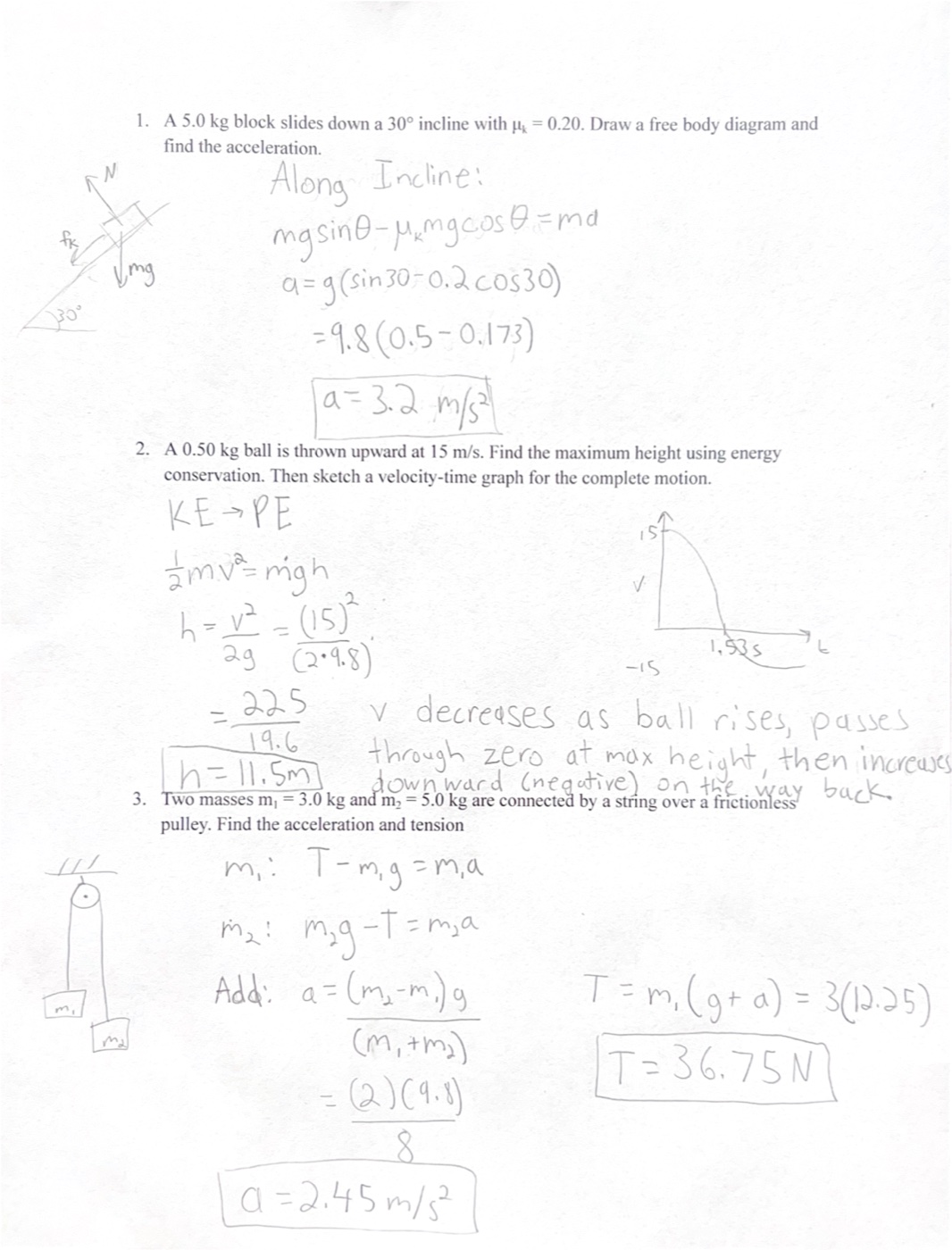
Question 1 — Inclined Plane (30 pts): 30/30
Free body diagram is complete with all three forces correctly identified and labeled. The decomposition into components was handled cleanly. Excellent work.
Question 2 — Energy & Kinematics (35 pts): 28/35
Energy conservation is correct and h = 11.5 m is right. However, the v-t graph is drawn as a curve when it should be a straight line. Under constant gravitational acceleration, v(t) = v₀ − gt is linear. Review Section 3.4 on uniformly accelerated motion to see why constant acceleration always produces a linear v-t graph (−7 pts).
Question 3 — Atwood Machine (35 pts): 35/35
Clear diagram. Newton's 2nd law applied correctly to each mass, then combined to eliminate T. Both a and T correct.
Grady's Feedback
From python notebooks to handwritten exams, Grady can evaluate all student assignments and all course subjects. Here are a few examples:
CHEM 261 – Midterm Exam: Organic Structures and Reactions
 Editable
Feedback:
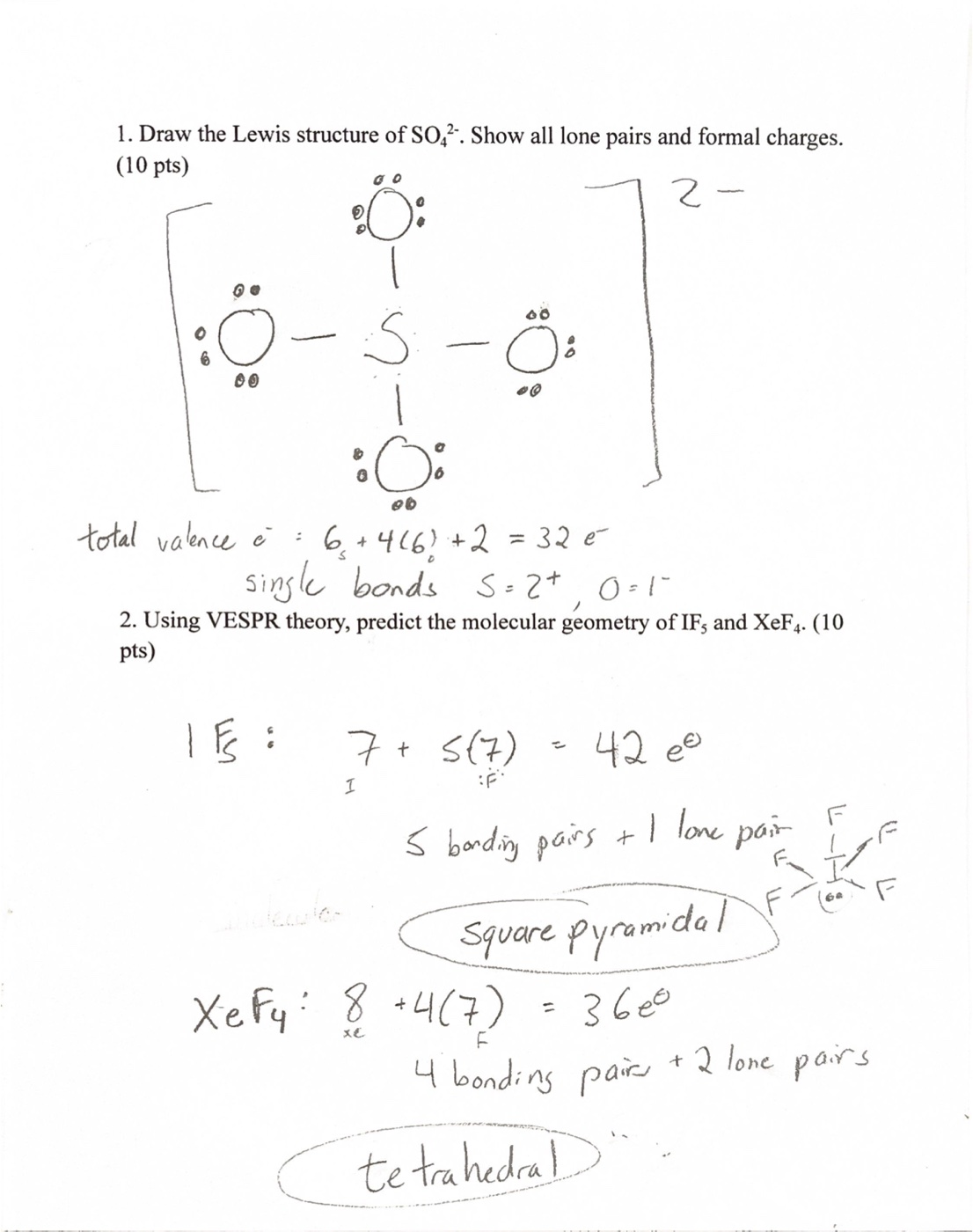
Question 1 (25 points)
16/25 – Lewis structure of SO₄²⁻ is mostly correct. You placed sulfur as the central atom with four oxygen atoms. However, you only drew single bonds to each oxygen. The expanded octet allows for double bonds, and the preferred structure has two S=O double bonds. Formal charges are incorrect on the singly-bonded oxygens.
Total Q1: 16/25
Question 2 (20 points)
13/20 – VSEPR geometry for IF₅ is correctly identified as square pyramidal. For XeF₄, you wrote tetrahedral. This is incorrect. XeF₄ has 6 electron groups (4 bonding, 2 lone pairs) giving square planar geometry.
Total Q2: 13/20
Question 3 (15 points)
10/15 – Correctly identified the hydroxyl, carbonyl, and amine groups. Missed the ester linkage in compound C. The C-O-C=O pattern is an ester, not a simple ether + ketone.
Total Q3: 10/15
Question 4 (20 points)
12/20 – The Friedel-Crafts acylation mechanism has the right general idea but your arrow-pushing has errors. In the ring attack step, the arrows should originate from the π electrons of the ring, not from a specific carbon atom.
Total Q4: 12/20
Question 5 (20 points)
12/20 – IR spectrum peaks correctly assigned for O-H stretch (broad, ~3300 cm⁻¹) and C=O stretch (~1715 cm⁻¹). The NMR interpretation is incomplete. You identified the methyl singlet but missed the characteristic splitting pattern of the ethyl group.
Total Q5: 12/20
Overall Comment:
Several areas need attention. The Lewis structure in Q1 needs expanded octet double bonds, the VSEPR geometry in Q2 must account for lone pairs on the central atom, and the spectral analysis in Q5 is incomplete. Review the relationship between electron-group geometry and molecular geometry.
Overall Score: 16+13+10+12+12 = 63/100
No course materials on hand? Not to worry.
We have prepared a full course example in the Grady app for you to try. Just log in to access it.
Grade an entire class in about an hour
Upload hundreds of exams and in about an hour each exam will have detailed, question-by-question feedback. The time you saved grading from scratch can be redirected to more student interaction or mentoring. Students get feedback while the material is still fresh — not weeks later.
- Faculty: Save hours or days
- Students: Feedback while it matters
Your voice, your standards, every time
Grady drafts; you decide. Review every grade, edit every comment, approve everything before it reaches students. And because every submission goes through the same process, every student gets the same depth and rigor, whether they’re first in the stack or last.
- Faculty: Full editorial control
- Students: Consistent, thorough feedback
Gain an aerial view of class comprehension
Class-level analytics surface which concepts need revisiting and which students need support. Faculty teach more effectively; students benefit from courses that adapt to actual learning gaps and get more targeted practice.
- Faculty: Actionable class analytics
- Students: More targeted instruction
Grade Distribution
Performance
Class Performance Summary
The class performed well overall on the Calculus II midterm, with a mean score of 84/100 and a median of 85/100. Students demonstrated strong competence in integration by substitution (Q1) and partial fraction decomposition (Q3). The primary area of difficulty was integration by parts (Q2), where 12 of 23 students made sign errors during evaluation — suggesting a procedural gap rather than a conceptual one. Graph labeling (Q4) was another common weakness, with 8 students omitting axis labels entirely.
Students
Common Errors
Created by faculty invested in excellence, Grady was built for the rigor of higher ed learning.
Taught at: MIT · Tsinghua · Columbia · NYU · Toronto · Rutgers · UIC
Rubric Construction
A powerful grader that can fluidly adapt to any subject and faculty direction. Our proprietary rubric engine interprets faculty instructions and builds rigorous, adaptable rubrics for any course or assessment format.
A powerful grader that can fluidly adapt to any subject and faculty direction. Our proprietary rubric engine interprets faculty instructions and builds rigorous, adaptable rubrics for any course or assessment format.
The university faculty who built Grady are experts in data privacy, cybersecurity, cryptology, and information security. They care deeply about Privacy and Ethical use of AI and Grady is a reflection of their commitment.
FERPA
GDPR
HECVAT 4
WCAG 2.2 AA
SOC 2 Type II
Always safe and secure from your first trial run with Grady to your 1000th graded assignment.
Its grading is broadly similar to human grading, and its ability to generate a marking rubric was excellent—in some cases more effective than a human’s. I think the core of what it is doing is amazing.
Alexander Paulin
UC Berkeley
Associate Teaching Professor of Mathematics
Overall the grading quality is impressive. The feedback that is provided is clear, helpful and should promote student learning.
Nakul Verma
Columbia University
Senior Teaching Faculty of Computer Science
I am very impressed. I believe Grady is more accurate than myself or any of my undergrad TAs and the amount of feedback given is more than I or my TAs would be reasonably able to provide.
Tim Carpenter
The Ohio State University
Senior Lecturer, Computer Science and Engineering
Ready to get started?
Bring Grady to your institution
Reach out to hear more about Grady or to see a demo.
Experience Grady yourself
Create an account and upload an assignment, or use an example we provide, to see Grady in action.
- Upload assignments in any format
- Get detailed feedback and grades in about an hour
- Full control to review and edit everything
- Works for any subject or discipline
- Gain a class summary with common error clusters to bolster teaching